Split-query RAG design patterns for reliable retrieval
Split-query RAG decomposes retrieval into locator, overview and content paths, then merges, reranks and falls back under SLO pressure.

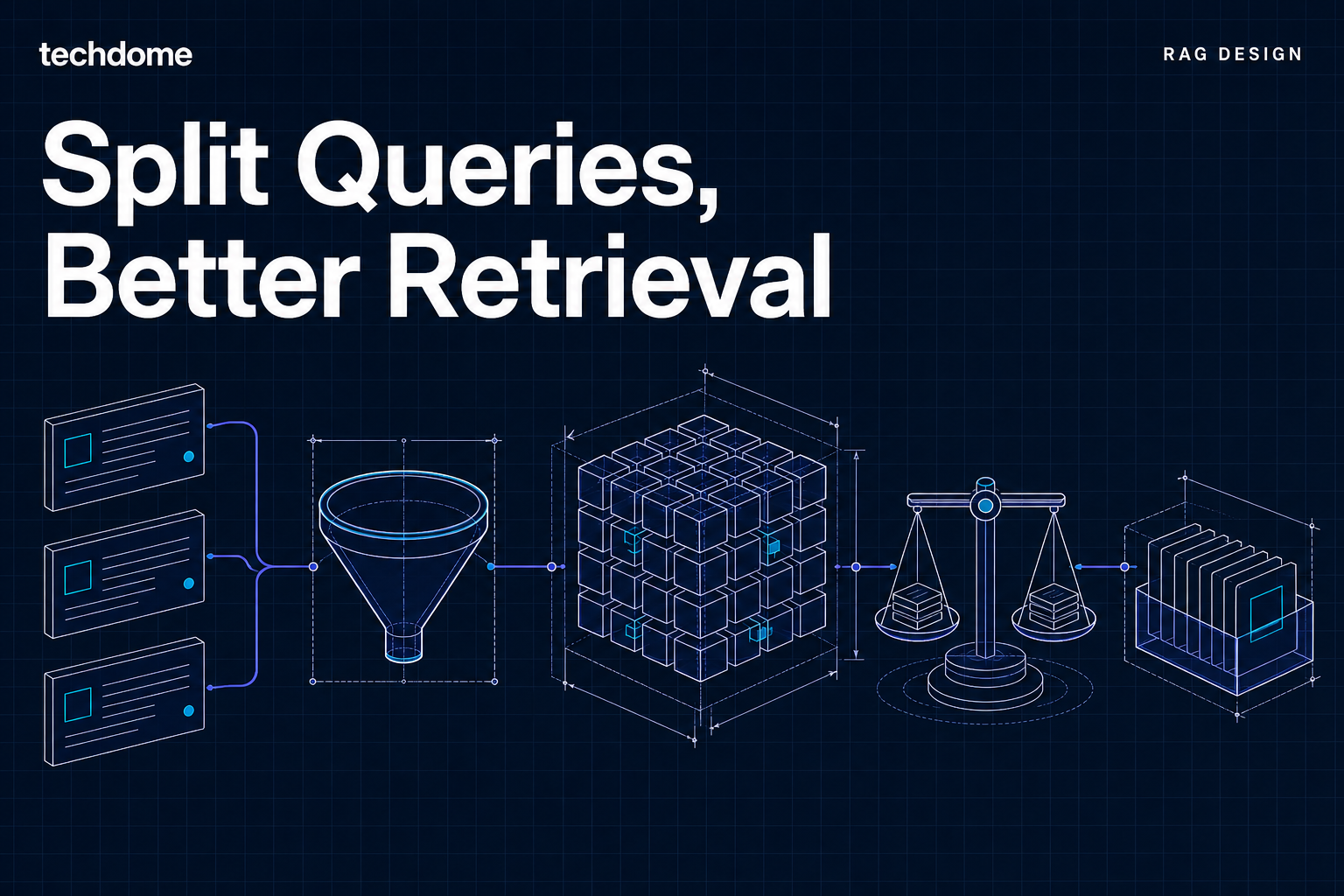
Split-query RAG is a retrieval design that breaks one user question into a few purpose-built searches, usually a locator query, an overview query and a content query. The decision is simple: use it when a single embedding search is missing exact constraints, broad context or fine-grained evidence that the answer depends on.
A single semantic query is often good enough for a narrow knowledge base with consistent document shape. It starts to fail when the user asks for a named policy, a date-bounded rule, a concept expressed in different words and a comparison across records in one sentence. Split-query RAG handles that by giving each retrieval path a narrower job, then merging and ranking the evidence before the generator sees it.
Split-query RAG design: locator, overview and content
A practical split is not many queries. It is three different jobs. A locator query finds precise objects: a file name, policy title, ticket id, customer account, date range or document tag. An overview query finds the parent section or high-level context that explains what the user is asking about. A content query finds fine-grained passages that contain the answer text, often through dense vector retrieval.
That distinction matters because each path should use a different retrieval bias:
- Locator handles exact tokens, metadata filters, ids, dates and access-controlled scopes.
- Overview handles rewritten intent, section-level context and disambiguation.
- Content handles semantic matches, paraphrases and detailed supporting passages.
Anthropic contextual retrieval describes techniques for improving retrieval by adding contextual information to chunks and combining contextual embeddings with contextual BM25. That supports the general point behind split-query design: the retrieval layer should not treat every question as the same kind of search.
A practical architecture looks like this: the query router extracts structured filters, creates or rewrites an intent query, runs sparse and dense retrieval in parallel, then merges and reranks candidates before generation. The generator should receive a compact evidence pack, not every raw hit from every retriever.
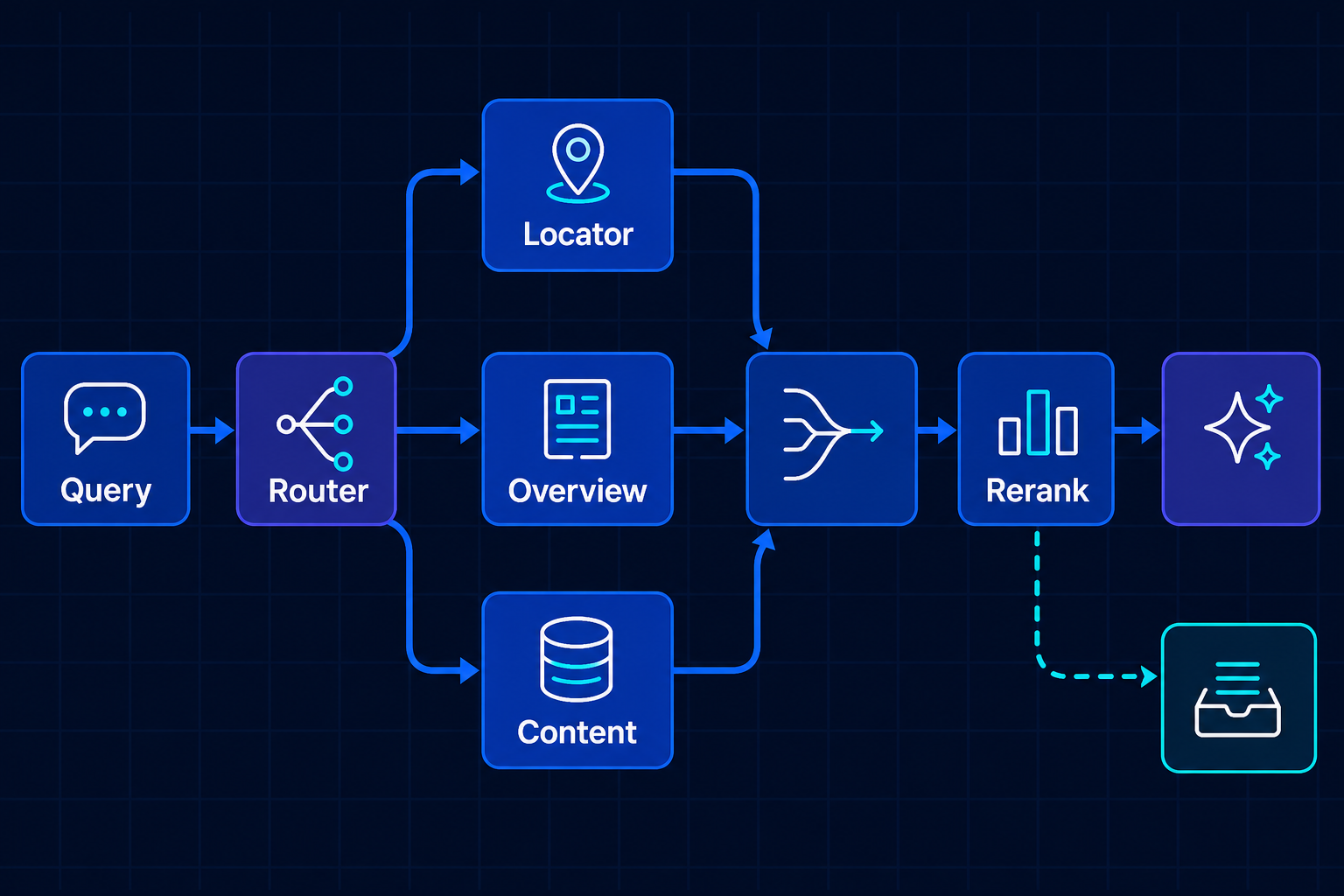
The split should stay small. If every user message turns into ten subqueries, the system becomes expensive and harder to debug. Start with two paths if the corpus is simple: locator plus dense content, or BM25 plus dense content. Add the overview path only when parent context changes answer quality.
Decompose queries without making retrieval opaque
There are three common decomposition methods. The first is deterministic parsing. Use it when the inputs contain known fields: dates, product ids, tenant ids, policy names, jurisdictions or document types. Rules are cheap, auditable and easy to test. They are also safer for access control because filters are created before retrieval, not after a model has seen unrestricted results.
The second is LLM query rewriting. LlamaIndex query transformations documents query transform patterns that generate variants or subquestions for retrieval. This is useful when user questions are open-ended, ambiguous or multi-intent. The cost is that the rewrite itself becomes another model call, another latency contributor and another thing to evaluate.
The third is hybrid decomposition. In many product systems, this is a practical default. Extract deterministic filters first, then use a small rewrite step for the remaining natural-language intent. For example, a support assistant might parse account id, product area and date range deterministically, then rewrite the user’s complaint into one or two semantic retrieval queries.
Keep the output of decomposition structured. A useful internal representation is not a list of strings. It should include query type, target index, filters, candidate budget and timeout. For example:
locator: strict metadata filters, BM25 or exact lookup, small candidate budget.overview: parent-document or section retrieval, moderate candidate budget.content: dense vector retrieval, larger candidate budget and stricter reranking.
This structure also makes testing easier. Retrieval bugs should be reproducible without the generator. LlamaIndex querying docs describe retrieval modes that help inspect returned nodes directly. A production RAG system should expose a similar internal path so engineers can tell whether the failure came from decomposition, retrieval, reranking or generation.
Merge, rerank and compress before generation
Merging is where split-query RAG either becomes reliable or turns into noisy fan-out. The safe default is union, deduplicate and aggregate by document. Deduplicate by stable document id when possible. If chunks have no stable id, use fuzzy content deduplication, but treat that as a fallback rather than the primary identity system.
Scoring needs normalization because BM25 scores, vector similarities and metadata matches are not naturally comparable. A simple production ranking function can combine signals such as retriever score, exact metadata match, recency, source authority and query-path weight. The locator path should usually have high trust for exact constraints; the dense content path should usually have high recall but lower final authority until reranked.
Reranking has three practical levels:
- Lightweight rerank: combine normalized sparse, dense and metadata scores into one scalar score.
- Cross-encoder rerank: run a neural relevance model on a reduced candidate set.
- LLM rerank: ask a model to reorder or select evidence using task-specific instructions.
The Intel-hosted LangChain Retrieval White Paper discusses retrieval pipelines that connect retrievers, rerankers and prompt construction. The important production habit is to avoid heavy reranking over an unbounded candidate set. Merge and prune first, then spend expensive ranking only where it can change the final answer.
Compression is the last step before generation. It can mean selecting only the top passages, extracting relevant sentences, summarizing long sections or stitching parent and child chunks. Compression is not free. It can remove details the answer needs, especially for compliance, medical, legal or technical support content. Test compressed context against raw context on labeled questions before making it the default.
Production SLOs, fallbacks and observability
Split-query RAG needs SLOs at two levels: the whole answer path and each retrieval component. Track latency by subquery, candidate counts, empty-result rates, reranker latency, generator latency and the final evidence set size. Also track retrieval quality separately from answer quality. A bad answer may come from the generator ignoring evidence, but it may also come from the retriever never finding the evidence.
For quality evaluation, keep a labeled query set. Measure per-path precision at k, recall at k and merged recall inside the context budget. Then evaluate generated answers using the same retrieved evidence. This separation prevents a common debugging trap: tuning prompts when the real failure is missing retrieval.
Fallbacks should be designed before launch, not after the first incident. Useful patterns include:
- If dense retrieval is slow, return locator plus BM25 evidence and mark the answer as best effort.
- If the reranker is unavailable, fall back to hybrid scoring with confidence metadata.
- If the overview rewrite fails, run locator and content paths without it.
- If the full path breaches the latency budget, return a short answer and queue a higher-quality re-enrichment job.
The async path is a system design decision, not just an AI decision. If you return a fast initial answer and compute a better answer later, you need job ownership, retry limits, idempotency and user-visible state. The same operational concerns discussed in message queues vs event streams apply here: work distribution and replayable event history solve different problems.
AWS Prescriptive Guidance includes RAG architecture options that support parallel retrieval and asynchronous enrichment patterns. For agentic systems, retrieval telemetry should sit beside model decisions, tool calls and human handoffs. That is also a recurring theme in production AI agent design: narrow jobs, logs and deterministic control points matter more than clever prompts alone.
Testing should include retrieval-only cases, end-to-end cases and failure injection. Retrieval-only tests prove that expected documents are returned without involving the generator. End-to-end tests prove that answers use the evidence correctly. Failure injection proves that degraded paths still produce safe behavior. The same discipline behind API testing strategy applies: automate stable contract checks first, then add scenario tests around realistic failure modes.
Trade-offs and when not to use split-query RAG
Split-query RAG buys recall and control, but it spends latency, read operations and engineering attention. Every extra path adds a timeout, an error mode, a candidate set and a merge rule. If your vector database bills by read units or your managed service has rate limits, fan-out matters. Vendor pricing pages such as Pinecone pricing and Weaviate pricing are design inputs, not procurement details, because candidate budgets and chunk counts affect runtime cost.
Do not use split-query RAG for a small, homogeneous corpus where a single hybrid retriever already returns the right evidence. Do not use it when users ask simple single-intent questions and the answer can be found by exact lookup. Do not add LLM query rewriting if deterministic filters cover the domain. Simpler retrieval is easier to evaluate and cheaper to operate.
Also be careful when access control is complex. Split-query can improve security if filters are enforced at retrieval time, but it can increase risk if one path forgets a tenant, role or document-level permission filter. Access control belongs in the retriever and index query, not in a final prompt instruction telling the generator to ignore restricted documents.
The hardest trade-off is synchronous quality versus user experience. A cross-encoder and compression step may improve answer quality, but they can make an interactive product feel slow. For internal research tools, that may be acceptable. For support, clinical, sales or operational workflows, it is often better to give a fast grounded answer, expose uncertainty and enrich later when the user asks for more detail.
How this looks in practice
The anonymised case study for A US Conversational AI Venture describes a production-grade multimodal conversational AI engine using n8n orchestration, LangChain and GraphRAG knowledge graphs with Apache AGE and pgvector. That architecture is relevant because graph relationships and vector similarity serve different retrieval jobs: one path can preserve structured memory and relationships, while another can retrieve semantically similar content.
The case study records these results exactly: Commercial Sprint: $10K; Delivery Time: 2–3 Wks; Architecture: GraphRAG. It is not proof that every RAG system needs split-query retrieval, but it is a useful pattern match: once a conversational system depends on structured memory, semantic recall and orchestration, retrieval needs explicit control points rather than one opaque search call.
Takeaways
- Split-query RAG is useful when one user question contains exact constraints, broad context needs and semantic evidence needs.
- Keep the split small: locator, overview and content are usually enough.
- Merge with deduplication and normalized scores before spending money on heavier reranking.
- Instrument each path separately so retrieval failures do not get hidden behind generator behavior.
- Use fallbacks deliberately: cheap retrieval, degraded ranking and async re-enrichment are production features, not afterthoughts.
If you are designing a RAG system with strict reliability or latency constraints, talk to Techdome’s engineers.
Further reading
- Aether Voice - A product example where low-latency conversational systems need grounded retrieval and routing.
- GPT-6.2 Astra vs Gemini 4 Hydrogen vs Anthropic 5.2 - Useful context for choosing the generator and evaluator models around retrieval.
- Sparrow - Helpful for teams that need fast API prototyping and test suites around retrieval services.
References
- Anthropic contextual retrieval - Supports contextual retrieval, hybrid retrieval and chunk context patterns.
- LlamaIndex query transformations - Supports query rewriting, query transformations and subquestion-style retrieval.
- LlamaIndex querying docs - Supports retrieval modes and debugging retrieval separately from generation.
- Intel-hosted LangChain Retrieval White Paper - Supports retriever, reranker and prompt pipeline discussion.
- AWS Prescriptive Guidance - Supports RAG architecture options and async enrichment patterns.
- Pinecone pricing - Supports cost planning around vector database reads, writes and deployment choices.
- Weaviate pricing - Supports managed vector database pricing and rate-limit planning.