
Telehealth software development for US and UK clinics.
Techdome builds multi-tenant, HIPAA-compliant telehealth platforms. Our flagship build is a GLP-1 weight-management platform for the US and UK with 38 clinic tenants (10 operating at scale) and 12,400+ patients: asynchronous chart review, prescriber licensing by jurisdiction, e-prescribing into 503A pharmacies and split billing.
- US, UK and India
- HIPAA and UK GDPR from day zero
- You own the code
New intake · PT-2041
- JurisdictionTexas, US
- BMI check31.2 · eligible
- Contraindication screenCleared
- IdentityVerified
Intake designed to finish in under 3.2 minutes
Illustrative screens. No real patient data.
- FHIR R4
- NCPDP SCRIPT EDI
- 21 CFR Part 11 signatures
- HIPAA
- UK GDPR
- White-labelled React web app
- Node.js
- PostgreSQL, multi-tenant
- AWS HIPAA infrastructure
- n8n automation
- Stripe Identity
- Split billing at capture
- 503A compounding partners
- Carrier webhooks and in-box loggers
- 38
- Clinic tenants, 10 operating at scale
- 12,400+
- Patients on the platform
- 33
- Engineers, architects and QA in the pod
- 6 months
- Initial build, then ongoing scaling
Who it is for
Who it is for
GLP-1 and weight-management ventures
You are launching or scaling clinics and need intake, prescribing and fulfilment working as one network.
Clinic networks
You want each clinic isolated, with its own roles, on one shared platform you can grow.
Founders replacing vendor tools
You have stitched several vendors together and the gaps show in compliance and in slow queues. We replaced four disconnected vendors with one clinical platform.
What we build
What a telehealth platform has to do
These are the stages of the platform we built, in the order a patient meets them.


Intake and eligibility
A structured questionnaire on a white-labelled web app, with BMI and contraindication checks before a physician sees the case.
Licensing by jurisdiction
The prescriber must be licensed where the patient lives: a US state board or the UK GMC. Routing checks live registries before assigning a queue.
Asynchronous chart review
A pre-compiled dossier for the physician, a 45-second review target and a signature, with escalation to a video visit.
Pharmacy routing
Signed orders go to the pharmacy over NCPDP SCRIPT EDI or to a 503A partner over REST, chosen on inventory, licensing and proximity.
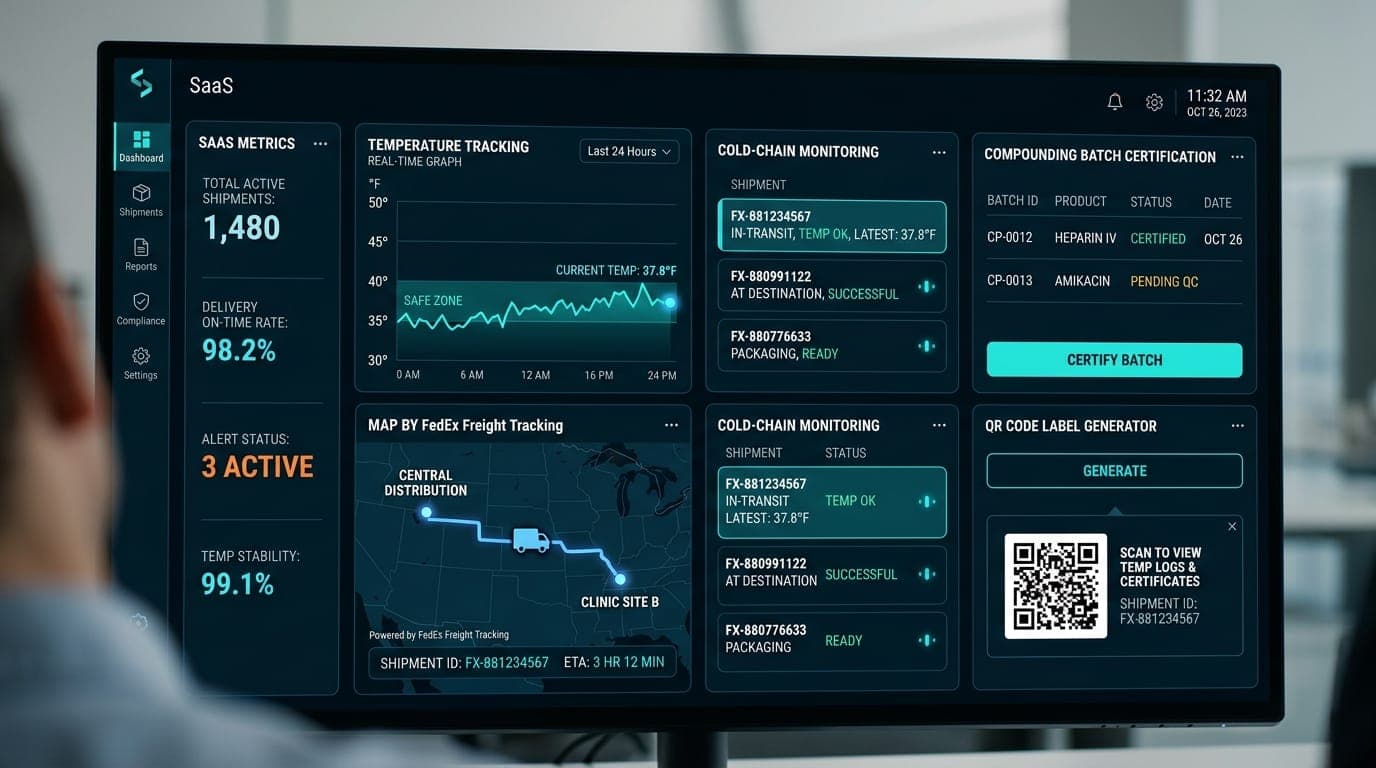
Cold-chain monitoring
Carrier webhooks and in-box loggers watch the 36 to 46°F window through the whole shipment.
Multi-tenant clinics and billing
Each clinic is an isolated tenant with its own roles, and split billing settles at capture.
How a build runs
Eight weeks, five steps, one deliverable each.
The same Blueprint we use for every product. Compliance work starts in week one, so nothing surprises you at launch.
- 01
Week 1
De-Risk & Architecture
System Architecture, Data Schema & Risk Matrix
We audit technical feasibility, lock compliance requirements (HIPAA/SOC2), design relational database models, and create interactive UX wireframes.
- 02
Week 2–3
Foundation & Core Engine
Working Backend API & Cloud Infrastructure
We provision cloud infrastructure, configure zero-trust authentication (OIDC/SAML), and build core business logic and third-party API adapters.
- 03
Week 4–6
Full-Stack Integration
Complete Feature-Complete Staging Application
We connect high-performance frontend interfaces with automated backend workflows, payment processing, and internal operational dashboards.
- 04
Week 7
Security, QA & Compliance
Pen-Test Review, WCAG 2.2 AA Audit & Load Tests
Exhaustive automated testing, accessibility auditing, vulnerability scanning, and end-to-end user scenario validation under high concurrency.
- 05
Week 8+
Production Launch & Handover
Live Production URL, CI/CD Pipelines & Telemetry
DNS cutover, real-time APM telemetry instrumentation, staff enablement training, and structured handover to ongoing growth pod or internal team.
Compliance
Built for HIPAA and UK GDPR from day zero
- HIPAA on AWS, with a BAA
- AWS HIPAA infrastructure under a signed BAA, with tenant data isolation and role-based access control.
- UK GDPR and a DPA
- UK patients are covered by a UK GDPR architecture and a data processing agreement.
- Signatures and audit
- Provider signatures follow 21 CFR Part 11 and every action goes to an append-only audit log.
- Data exchange
- FHIR R4 for clinical data and NCPDP SCRIPT for prescriptions.
Clinical standards
- FHIR R4
- NCPDP SCRIPT EDI
- 21 CFR Part 11 signatures
- HIPAA
- UK GDPR
Platform
- White-labelled React web app
- Node.js
- PostgreSQL, multi-tenant
- AWS HIPAA infrastructure
- n8n automation
Identity, billing and fulfilment
- Stripe Identity
- Split billing at capture
- 503A compounding partners
- Carrier webhooks and in-box loggers
Pitfalls
Where telehealth builds go wrong
Five patterns, and the design that avoids each.
Compliance added after launch
HIPAA and UK GDPR controls are cheapest as architecture. Retrofitting them is the most expensive mistake in this category.
Licence checks done by hand
Matching prescribers to patients by hand does not scale across 50 US states and the UK. Route by jurisdiction against live registries.
A review queue nobody designed
A physician needs the whole case on one screen. We designed around a 45-second review target and a one-step escalation to video.
Forgetting the cold chain
Medicine that leaves its temperature window is a refund and a risk. Watch the shipment through transit, not only the order.
Billing as an afterthought
Bolt-on billing lets the books drift. Settle splits at capture so the platform and each clinic stay in step.
Before you hire anyone
Six questions to ask a telehealth development partner
They apply to any partner. The answers tell you how much of the hard part they have done before.
How do you match a prescriber’s licence to the patient’s location?
Ask for a rule-based check against live registries, not a manual list.
How long should a physician need to review a case?
A partner who has measured this can give you a target and show how the screen is built for it.
How do prescriptions reach a pharmacy?
Look for standard messages such as NCPDP SCRIPT, and a choice of pharmacy by inventory and licence.
How do you monitor temperature-sensitive shipments?
Carrier data and in-box loggers beat a signature at delivery.
Can each clinic be isolated on one platform?
Ask how isolation is enforced and how it is tested.
Will you sign a BAA, and a DPA for UK patients?
Both should be in place before patient data is touched.
Proof
The telehealth build, and the healthcare work around it
Client names stay private. The build and the outcomes are real.
United States & UK
A US & UK Telehealth Platform (GLP-1 Space)
Multi-tenant clinical operating platform across the US and UK for the GLP-1 surge: synchronous/asynchronous EMR, compliant e-prescribe, automated pharmacy routing, and split-billing with day-zero HIPAA and UK GDPR architecture.
- Clinic Tenants
- 38
- Active Users
- 12,400+

United States (Southwest)
An Executive-Health Clinic Group
Transitioning complex executive-health clinic ops from a fragile low-code stack to an offline-first Next.js PWA with zero downtime, live payment processing, and HIPAA + PCI-DSS compliance.
- Proposal to Kickoff
- 8 Days
- Phases 1 & 2
- Go-Live
- Virtual Care & Health SaaS
United States
A Multi-Vendor Telehealth Care Ecosystem
Consolidating five disconnected health vendors and authentication silos into a single sign-on (SSO) architecture with automated payment-to-care pipelines and lifecycle triggers.
- Deal to Kickoff
- ~2.5 Wks
- Follow-on SOW
- 13 Days
Pricing
Three ways to start.
Fixed scope and dates agreed before work begins. You own the code, the repositories and the infrastructure once milestones are paid.
Fixed-scope sprint
For one defined piece of work
From $8,000
For a defined piece of work that is smaller than a full MVP, agreed up front.
How sprints work- For a new platform
MVP
From $25,000
Typically 8 to 12 weeks, scoped with our Blueprint, to a working product that you own.
How the studio works Per engineer
For a team on your roadmap
$25 to $45 an hour
All-in. At full time (160 hours) that is about $4,000 to $7,200 per engineer per month, depending on seniority.
How pods work
Full terms are on the pricing page. The MVP cost estimator gives a first range before a call.
Read next
Guides from the same work.
- ++++Healthcare AIOct 28, 2026·2 min read
Telehealth metrics and KPIs: the numbers that matter
The 15 telehealth metrics an operator should track, from intake completion to time to physician decision and cold-chain excursions, with real figures from a US and UK GLP-1 platform.
Techdome EngineeringEngineering Team
- ++++Healthcare AIOct 28, 2026·3 min read
How to build a GLP-1 telehealth platform
A builder's guide to a GLP-1 telehealth platform: compliance, multi-tenant clinics, eligibility checks, licensing by jurisdiction, chart review, pharmacy routing, cold chain and billing.
Techdome EngineeringEngineering Team - ++++Healthcare AIOct 28, 2026·4 min read
Telehealth compliance checklist for the US and UK
An engineering checklist for a telehealth platform serving US and UK patients: contracts, access and audit, clinic isolation, licensing by jurisdiction, prescribing, signatures, payments and incidents.
Techdome EngineeringEngineering Team
Straight answers on scope, compliance, timelines and cost.
It depends on scope: the number of clinics, the integrations and the compliance regions. Our pricing page lists the engagement models, and the MVP cost estimator gives a first range before you book a call.
Building for clinics, labs or a digital health venture?
Tell us what you are building. You talk to an architect, not a salesperson, and leave with a scope and a range.